The window will not move
The plant comes back on the committed date whether the work is done or not, so a slip on a critical job is lost production, not a softer deadline.
SHUTDOWN AND TURNAROUND GOVERNANCE
Shutdown planning software built around the one thing that decides whether you hand the plant back on time: the critical path. Phaselo projects the outage finish date, measures slip against the baseline you set before the window opened, and keeps the record of what moved and why for the post-outage review.
Now onboarding first teams · No credit card · $8/user/month
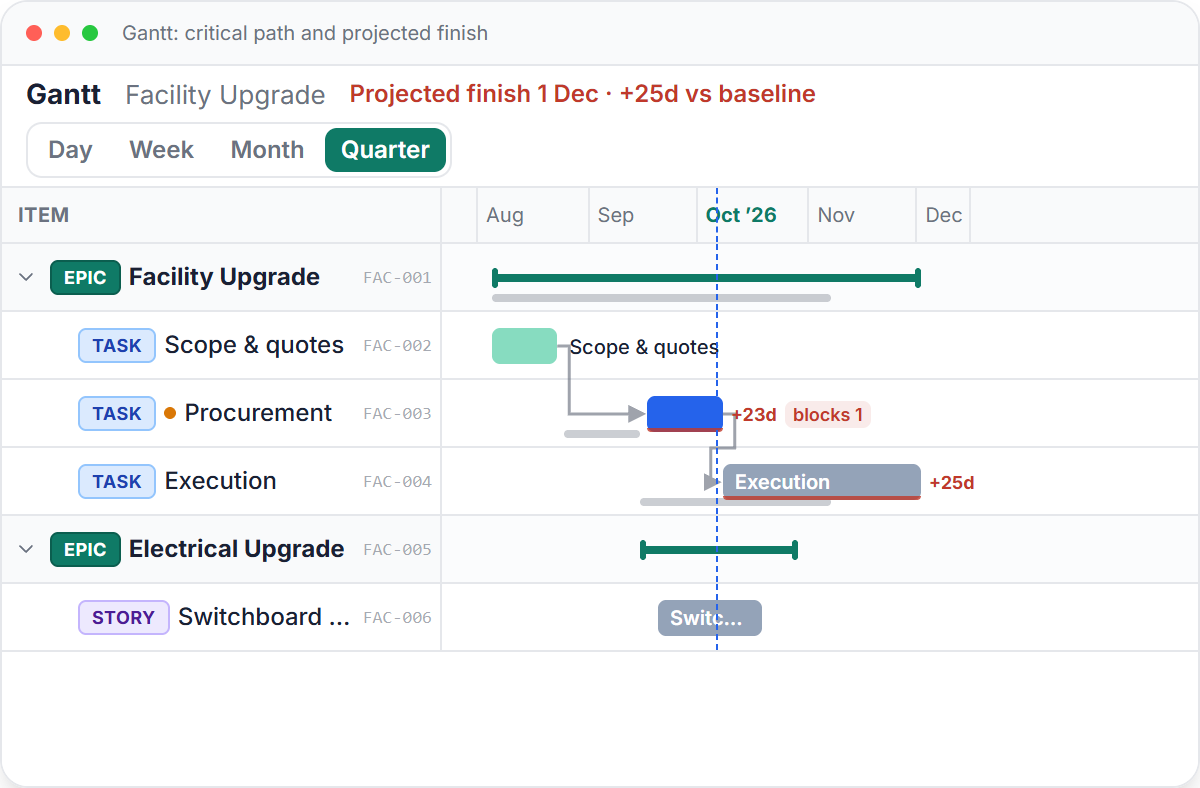
The problem
A shutdown is not a normal project. The window is fixed and short, the work front is packed, and the moment one critical job slips the whole restart slips with it. Every day past the planned hand-back is lost production measured in real dollars, and when the outage is over, someone is going to ask why the schedule moved. A spreadsheet does not project the finish, it does not warn you the critical path has changed, and it does not hold an honest record of the decisions made at 2am on the floor.
The plant comes back on the committed date whether the work is done or not, so a slip on a critical job is lost production, not a softer deadline.
As discovery work and found jobs land, the longest path through the outage moves, and a static bar chart will not tell you which task now drives the restart.
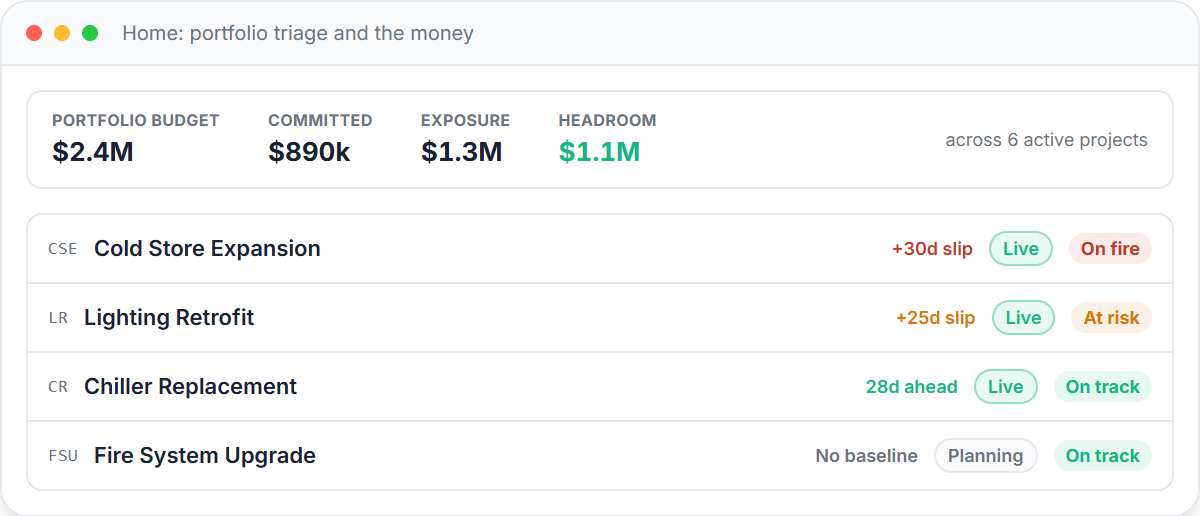
Each day past hand-back is measured production lost, but the cost of a slip is rarely sitting next to the task that caused it.
When the review asks why the turnaround ran two days long, you need the original plan and the recorded reasons, not memory and a thread of emails.
How Phaselo handles it
Phaselo runs a real critical-path engine over the outage: break it into phases, a package for each trade, and tasks, set the dependencies, and it returns the projected hand-back date and the path that drives it, recalculated as progress and dates change. When a task goes overdue or a live shutdown is projected past its baseline, in-app and email alerts reach you while there is still time to move crews, not after the trades have stood down.
You set the baseline at go-live, before the outage opens, and every day of slip is measured against that committed plan rather than a target that quietly drifts. Re-baselining is allowed when the scope genuinely changes, but it requires a written reason that is recorded, so the post-outage review reads the original commitment and the documented decision side by side.
A triage board sorts every active shutdown into on-fire, at-risk, and on-track so you work the outage about to overrun first. Cost rolls up by cost centre into budget, committed, exposure, and headroom, and a capex request freezes its figures at generation for offline sign-off, so the document you take to the sponsor cannot disagree with what the turnaround is actually spending.
Built for this work
Break the project into phases, work packages, and tasks, set the dependencies, and Phaselo returns the projected finish and the critical path. Go live to lock the baseline, then track slip against it as the work moves.
Pricing
$8 per user per month, flat. No tiers, no caps. Every plan includes the critical-path engine, baseline governance, the audit trail, slip alerts, and all five views. Now onboarding first teams, no credit card.
FAQ
Look for a tool that runs a real critical-path engine, not just a bar chart. Phaselo breaks the outage into work packages and tasks, you set the dependencies, and it returns the projected hand-back date and the critical path that drives it, recalculated as progress changes. It also shows total float per task so you act on what moves the restart, not what just looks busy. Pricing is $8 per user per month, flat, with a 14-day free trial and no credit card.
A shutdown has a fixed, short window where the critical path decides the hand-back date, so the value is in projecting the finish and warning you the moment a critical job turns. Phaselo focuses on exactly that: a live critical-path engine, proactive overdue and slip alerts in-app and by email, and a baseline you set before the window that slip is always measured against. To be honest about scope, there is no approval workflow, no resource levelling, and no AI.
Yes. Phaselo watches every live shutdown and sends an alert, in-app and by email, when a task goes overdue or the projected finish slips past the baseline you set at go-live. You hear it from the system while you can still re-sequence work or add a crew, instead of finding out on a site call after the trades have arrived.
Phaselo keeps an append-only audit trail of who changed what, when, and why, and entries are never edited or deleted. The baseline is captured before the window opens, and any re-baseline requires a recorded written reason. When the review asks why the turnaround ran long, you have the original plan and the documented decisions in one place rather than reconstructing it from email.
Phaselo is $8 per user per month, flat, with no tiers and no caps. A 20-person turnaround team pays $160 a month, and that includes the full critical-path engine, baseline tracking, alerts, audit trail, money roll-up, and unlimited projects. There is a 14-day free trial with no credit card, and it works on mobile so the crew can update progress from the floor.
A practical maintenance shutdown planning guide: phases, work packages, backward scheduling, contractor coordination, and the tools that beat Excel.
Read the guide →An equipment commissioning checklist run as a live project plan: 5 phases, cold vs hot commissioning, acceptance tests, punch lists, and a clean handover.
Read the guide →Start a free 14-day trial, no credit card. Bring your work packages and cost centres, and see the projected hand-back, the slip against baseline, and the cost of every day over before the window opens.
Request early access