A checklist cannot slip
A static commissioning checklist treats every line as equal and timeless, so it cannot tell you a two-day delay in cold commissioning has pushed the go-live until the date has already passed.
FOR COMMISSIONING ENGINEERS
A commissioning management system that runs your checklist as a live plan, with a critical path, a baseline, and a punch list that does not go stale. Commissioning is the dependency-heavy tail of a capital project, and this is where you keep the go-live date honest.
Every new project can start from a built-in equipment installation template: procurement, site preparation, installation, commissioning and handover. Dates and dependencies included; edit everything.
14-day free trial · No credit card · Founding price $99/month for the first 10 teams

The problem
By the time a capital project reaches commissioning, the budget is mostly spent and the pressure to hand over is highest. The work is checklist and sign-off heavy, vendor-dependent, and full of gates: no hot commissioning with a safety-critical punch item open, no handover until production signs. The trouble is that a checklist in a Word document does not recompute anything. Cold commissioning slips two days, the performance run lands in the vendor's demobilisation week, and nobody sees it until the steering meeting.
A static commissioning checklist treats every line as equal and timeless, so it cannot tell you a two-day delay in cold commissioning has pushed the go-live until the date has already passed.
A defect list exported to a PDF is wrong by the afternoon, and nobody can say how many items are open or how many are safety-critical and blocking hot commissioning.
Commissioning lives on vendor support and documentation, and one late delivery or an early demobilisation moves the performance run and the handover with it.
The equipment runs, the project team drifts to the next job, and six weeks later maintenance finds no greasing schedule, no as-builts, and no recorded warranty contact.
How Phaselo handles it
Build the commissioning phases on a critical-path timeline and the projected finish date recomputes as vendors slip and progress changes, with total float showing which late tasks bite the go-live and which have slack. Proactive overdue and slip alerts reach the owner of a late task in-app and by email, so a delay in the reliability run is visible the same day, not at the next meeting.
Capture the baseline at go-live and slip is always measured against the plan you committed to at sign-off, not a number that drifts. Every scope change, re-baseline, and closed punch item lands in an append-only audit trail, so when finance asks why commissioning ran over you point at the baseline and the recorded reasons, not your inbox.
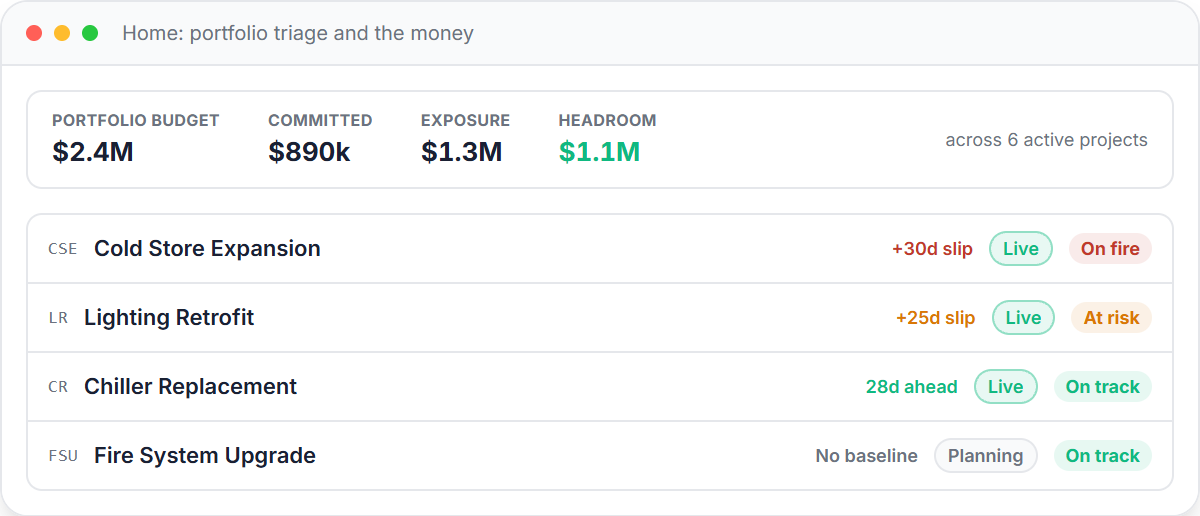
Commissioning cost rolls up by cost centre into budget, committed, forecast, and headroom, and a capex request freezes its figures when you generate it, for sign-off in your own approval chain against the final milestones. The portfolio triage board sorts your active startups into on-fire, at-risk, and on-track, so when three commissions run at once you know which one needs you today.
Built for this work
Break the project into phases, packages, and tasks, set the dependencies, and Phaselo returns the projected finish and the critical path. Go live to lock the baseline, then track slip against it as the work moves.
Pricing
Founding teams pay $99 a month, held for 12 months, for the first 10 organisations; after that the price is $399 a month, or $3,990 a year. Either way it is one price for the whole organisation, with unlimited people and unlimited projects. Every plan includes the critical-path engine, baseline governance, the audit trail, slip alerts, capex requests and the punch list, with a free trial and no credit card.
FAQ
The best fit for plant startup is software that runs your commissioning checklist as a live project plan with a real critical path, not a static document. Phaselo structures commissioning as phases, packages, and tasks with dependencies, recomputes the projected finish as vendors slip, and keeps a punch list where every defect has an owner, a severity, and a photo. It starts at $99 a month for founding teams, one price for the whole organisation, with a 14-day free trial and no credit card.
Partly, and it is worth being exact about which part. If completions management to you means running systems and subsystems to a dated plan, holding the punch list against them, gating handover until the blocking items are closed, and keeping a record of who signed what and when, that is what Phaselo does. If it means generated ITRs, certificate templates, and a formal system and subsystem register of the kind a large EPC contract mandates, it does not do that, and a dedicated completions package will serve you better. Phaselo is the schedule, the money, and the record around commissioning rather than the certificate library inside it.
A checklist records what has been done. A commissioning management system knows what the remaining work depends on, so it can tell you what the go-live date now is. Phaselo holds commissioning as phases, packages, and tasks with real dependencies, so when cold commissioning slips two days the performance run and the handover move with it and the projected finish updates the same day. Operational commissioning is dependency-heavy and vendor-dependent, which is exactly the shape a static document cannot represent.
Keep it in the project, not in a PDF. In Phaselo each defect is raised with its location, severity, owner, and a photo taken on the spot, and it moves from Open to Fixed to Verified. Fixed is the contractor's claim and Verified is the project accepting it, which only a project admin can do, so a critical defect keeps blocking handover until someone has checked it. At any moment you can see how many items are open and which ones block the gate, and closing the project names any that are still outstanding.
It captures a baseline at go-live, then measures slip as the gap between that baseline and the projected finish, which the critical-path engine recomputes as dates and progress change. Phaselo shows the slip the day it opens and sends proactive alerts when a task is overdue or a live project is projected past its baseline. When a re-baseline is genuinely needed because scope grew or a vendor delivery moved, it requires a recorded written reason and stays in the audit trail.
Phaselo handles handover as a gated task, not an email saying it is done. Make production's sign-off a task with a name and a date, with the as-builts, maintenance plan, warranty record, and spares confirmation as its dependencies, so acceptance is not granted until the artefacts exist. The append-only audit trail records who signed and when, and closing the project checks the punch list, names any defect still blocking handover, and freezes a closeout pack of the as-built record. Maintenance starts from a clean record instead of a mystery.
Founding teams pay $99 a month, held for 12 months, for the first 10 organisations; after that the price is $399 a month, or $3,990 a year. Either way it is one price for the whole organisation, with unlimited people and unlimited projects, and it works on mobile so status comes from the floor. There is a 14-day free trial with no credit card required. For an honest comparison, Phaselo has no approval workflow, no resource levelling, and no AI: it is the projected finish, the honest slip, and the record to back both.
An equipment commissioning checklist run as a live project plan: 5 phases, cold vs hot commissioning, acceptance tests, punch lists, and a clean handover.
Read the guide →A practical maintenance shutdown planning guide: phases, work packages, backward scheduling, contractor coordination, and the tools that beat Excel.
Read the guide →Make each commissioning stage a phase, each checklist line a task with one owner and one date, and log every punch item on the punch list with its severity and a photo, then watch the projected finish and the slip move on their own. Phaselo starts at $99 a month for founding teams, one price for the whole organisation, with a 14-day free trial and no credit card.
Start free trial