Act on what moves the date
Zero-float tasks set the deadline, so you put attention there instead of on whatever looks busiest this week.
CRITICAL-PATH ENGINE
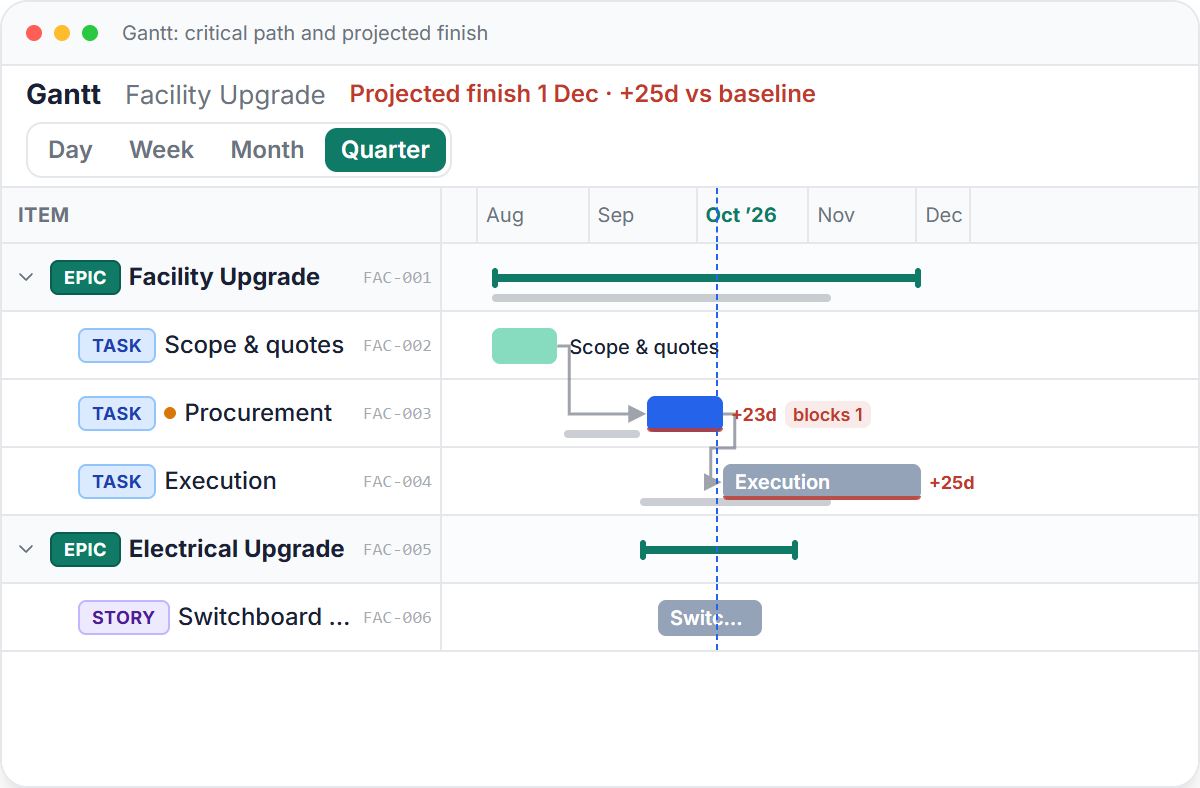
Critical path software that runs a real CPM pass over your task network, not a coloured bar chart. You get each task's float, the chain of zero-float tasks that sets the deadline, and the projected finish date for the whole project.
Now onboarding first teams · No credit card · $8/user/month
What it does
Most schedule tools draw bars and call it a plan. Phaselo runs the critical path method over the dependencies you set, then tells you two things that matter: which tasks decide the finish date, and what that date actually is. You break the work into phases, packages, and tasks, link what depends on what, and the engine does the arithmetic. Change a date or a dependency and it runs again. No guessing about which slip you can absorb and which one moves the deadline.
How it works
You structure the project as phase over package over task. A phase is a stage of the job, a package groups the work inside it, and tasks are the units that carry dates and a duration.
You link each task to the ones it depends on. Those links form a network, the directed graph the engine walks. No links means no critical path, so the dependencies are the input that makes the rest work.
The engine walks the network from the start, adding durations along each chain, to compute the earliest each task can start and finish. The latest early finish across the whole network is the projected finish date for the project.
Working back from that finish, the engine computes the latest each task can start and finish without pushing the deadline. Late minus early on any task is its total float, the slack you have before that task starts costing you days.
Tasks with zero total float have no slack: slip one day and the project slips one day. That chain of zero-float tasks is the critical path, the longest path through the network, and the Gantt draws it so you see it, not just the bars.
Why it matters
Zero-float tasks set the deadline, so you put attention there instead of on whatever looks busiest this week.
The longest path gives a projected finish date you can defend in a status meeting, not a hope pinned to the end of a summary bar.
Every date edit and dependency change reruns the passes, so the float and the finish date reflect the plan as it is now, not as it was at kickoff.
In the product
Pricing
$8 per user per month, flat. No tiers, no caps. The critical-path engine, baseline governance, the audit trail, slip alerts, the money roll-up, and all five views are in every plan. Now onboarding first teams, no credit card.
FAQ
A Gantt chart draws bars from the dates you type. Phaselo runs the critical path method over your dependencies: a forward and backward pass that computes early and late dates and total float for every task. From that it derives the critical path and the projected finish date, then redraws the Gantt to mark the path. The bars are an output of the engine, not the input.
The forward pass walks the dependency network from the start, adding each task's duration along every chain to find the earliest each task can finish. The latest of those early finishes, across the whole network, is the projected finish date. It is the end of the longest path through your tasks, so it reflects the real chain of work rather than a date you set on the phase.
Total float is how many days a task can slip before it pushes the project deadline. The engine gets it by subtracting each task's early dates from its late dates. Tasks with float to spare can absorb a delay. Tasks with zero float cannot, and those are the ones on the critical path that you protect first.
Yes. The engine reruns the forward and backward pass whenever a date or a dependency changes. Total float, the set of zero-float tasks, and the projected finish date all recompute, so the critical path you see is always based on the current plan, not the original one. To be precise, it models the dependency network: partial-progress recalculation is deliberately out of scope.
No. It is the critical path method applied honestly: dependencies in, early and late dates, total float, the critical path, and a projected finish date out. There is no resource levelling, no approval workflow, and no AI. What you get is the projected finish, the float on each task, and a clear view of which tasks own the deadline.
A practical maintenance shutdown planning guide: phases, work packages, backward scheduling, contractor coordination, and the tools that beat Excel.
Read the guide →Phaselo is $8 per user per month, flat, with unlimited projects and a 14-day free trial, no credit card. Set your dependencies and the engine will tell you which tasks own the deadline and where the project lands.
Request early access